Meta Ads ROAS Suddenly Dropping? The 5-Step Diagnosis Method for the 2026 Andromeda Era

ROAS Dropped from 4 to 2? Don't Rush to Increase Budget
The 5-Step Diagnosis Method for the 2026 Andromeda Era — Recover Ad Performance in 14 Days
Meta Ads ROAS dropped from a steady 4 to 2 in just two weeks — revenue nearly cut in half. This is the number many e-commerce brand owners are seeing in their dashboards in 2026. Most people's first instinct is to increase budget to save orders, but this move often amplifies the problem rather than solving it.
Throwing more budget at a sick ad account won't fix it. In practitioner experience, ROAS declines are rarely about "the market getting worse" — they're usually about a signal breakdown somewhere in your advertising system. It is rarely the case that the market has genuinely deteriorated, yet advertisers almost always assume it's a market problem, make the wrong decisions, and wipe out all the algorithmic learning they've painstakingly accumulated.
This article breaks down the ROAS decline diagnosis process for 2026 ad campaigns using 5 steps. After reading it, the next time you see your numbers tank, you won't rush to adjust budgets or pause campaigns.
Meta Ads ROAS Decline — Don't Panic-Adjust Budgets

Step zero is always to observe first — don't touch anything. Meta Ads ROAS fluctuating 30% on a single day is normal noise. What you need to watch is the 7-day rolling average, not today's number.
A reasonable threshold is: 5 consecutive days where ROAS falls 25% below the previous 14-day average qualifies as a decline alert; 40% below is an emergency. If it dips just for a day and bounces back, it's usually Meta's algorithm doing exploration — no intervention needed.
Many media buyers see numbers drop and immediately increase budget or pause campaigns, which resets the learning phase and wipes out all accumulated signals. The real recovery rhythm is "diagnose first, prescribe second, fine-tune last" — reversing the order only makes things worse. Plenty of e-commerce brands keep their Meta algorithm perpetually in learning mode because they can't stop fiddling with settings, so ROAS never stabilizes.
Step 1: Check Pixel & CAPI Conversion Signal Integrity
With iOS privacy restrictions tightening further in 2026, ad accounts without a properly integrated Conversions API (CAPI) can have ROAS data errors of 30% to 40%. That means you could think your account is profitable when it's actually losing money — or vice versa. (Source: leoads.ai, iOS 14.5 ATT impact analysis)
Four Signals to Check
1 Event Match Quality Score in Pixel Events Manager
Is it 7 or above? Below 7 means serious tracking signal loss — your ROAS numbers are unreliable.
2 Data Deduplication Rate
Is it in the healthy 60% to 80% range? Too low means double-counting (inflated ROAS); too high means missed conversions.
3 EMQ (Event Match Quality) Ratings
Are all events rated Good or Great? If any show Poor or Fair, fix those first.
4 Purchase Event content_ids vs. Product Catalog
Do they match up? This is the most common issue after e-commerce platform migrations. If content_ids don't carry over, Meta's algorithm treats pre- and post-migration products as entirely new, learning from scratch.
Critical Reminder
If any of these four has an issue, the numbers you're seeing are distorted. Don't touch your ad settings — fix your tracking first. Without a solid foundation, all optimization is building on sand. The most common scenario: after an e-commerce platform migration with broken content_ids, ROAS drops 30% to 50% within two weeks.
Step 2: Watch Hook Rate & Hold Rate as Leading Indicators
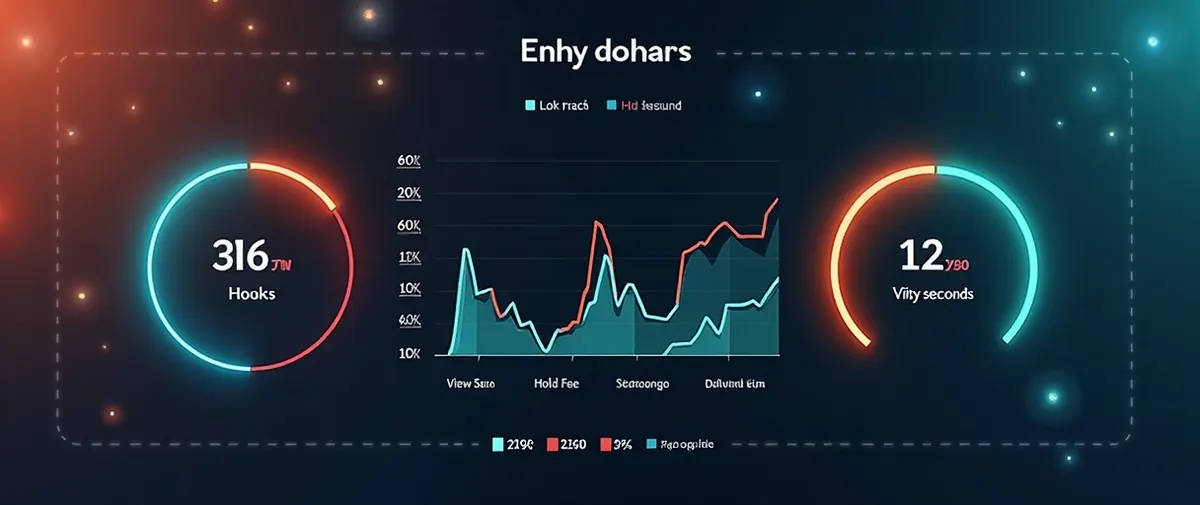
Meta Ads ROAS is an "outcome metric" — it tells you the problem has already happened. The real leading indicators are Hook Rate (first 3-second view rate) and Hold Rate (15+ second view rate).
Healthy Benchmarks & Lead Time
Hook Rate
Hold Rate
Industry practitioner benchmark (aggregated across multiple Meta ad analytics platforms; not an official Meta figure): Hook Rate above 30%, Hold Rate above 15%. Below both thresholds means your creative is already losing appeal — a ROAS decline is only a matter of time. In practice, Hook Rate leads ROAS decline by about 3 to 5 days, Hold Rate by about 5 to 7 days. If you swap creatives when Hook Rate starts slipping, you can often stop the bleeding before ROAS drops.
This is why you need to review creative-level data daily, not just total ROAS at the ad set or campaign level. Creative-level granularity tells you exactly which video is dragging down the entire ad group. The practical workflow: add Hook Rate and Hold Rate to your daily monitoring dashboard, set up automated alerts when they drop below threshold — your reaction speed will be 2 to 3 days faster than manual daily checks.
Step 3: Check If Andromeda Algorithm Is Burning Through Your Creative Diversity

Meta's Andromeda algorithm, fully rolled out by late 2025, has compressed creative lifespan to just 14 to 21 days. Running the same creative beyond 21 days will almost certainly tank your Meta Ads ROAS — it's practically a law. Andromeda's visual analysis determines in milliseconds whether a creative has "been seen before," so minor tweaks like changing a background color or caption won't register as a new creative.
Creative Rotation Cadence by AOV
| Average Order Value | Creative Rotation Frequency |
|---|---|
| Under $20 | Every 7-10 days |
| $20 to $70 | Every 14 days |
| Above $70 | Every 21-28 days |
But "swapping creatives" doesn't mean "changing the background color." Truly effective creative diversity requires rotating across three dimensions: narrative angle, camera style, and model type. Narrative angles can include pain-point openings, result-driven openings, or social proof openings. Camera styles can be direct-to-camera, street interview, UGC imitation, or product close-ups. Model types span age, gender, and image differences. When rotated correctly, ROAS typically stabilizes within 5 to 7 days.
The Practical Creative Production Cadence
Maintain a rolling "3 main + 2 experimental" configuration. Main creatives are versions with proven stable performance; experimental creatives test new angles. Every two weeks, retire the worst-performing main creative and replace it with a successful experimental one. This keeps your creative library in a constant state of exploration, feeding Andromeda fresh signals instead of letting the same fatigued creatives drag everything down.
Step 4: Check If Your Audience Targeting Is Too Narrow

Since Andromeda went live, Meta has significantly reduced the weight of advertiser-defined audience targeting. Interest tags are now treated as "suggestions" rather than "conditions." If you're still using the old "narrow targeting + multi-layer audiences" approach, your Meta Ads ROAS will actually be constrained because the algorithm doesn't have enough exploration space.
Meta officially recommends broad targeting across four dimensions: age (20+ range), gender, country, and language. Hand the judgment to the algorithm and let it find the people with the clearest conversion signals in a larger pool. Switching from narrow targeting (under 500K audience size) to broad targeting (2M+ audience size) typically delivers a noticeable ROAS improvement. But the prerequisite is clean Pixel/CAPI conversion signals — otherwise the algorithm can't find the right people and will burn budget on non-buyers instead.
Important Distinction
"Broad targeting" does not mean "spray and pray." You still need exclusion logic — exclude existing customers and people who purchased within the last 30 days from cold audience ad sets to avoid wasting budget on repeat impressions. The industry standard is broad targeting for cold audiences and precise lists for retargeting, operating the two layers separately.
Step 5: Set Red Lines & a Rescue Timeline
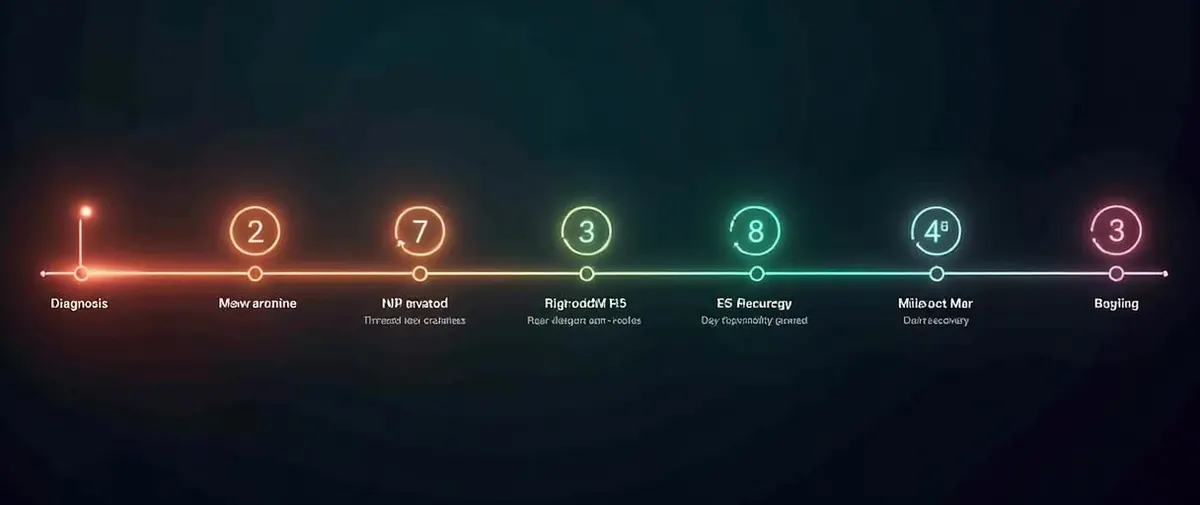
The final step is setting clear rescue targets. A reasonable timeline looks roughly like this:
Complete all five diagnostic checks, identify the problem layer
Launch 3-5 new creative angles, enter a new exploration phase
Expect Hook Rate to return above 30%
Expect Meta Ads ROAS to recover to 80% of original level
Expect full recovery or exceeding original performance
If you can't pull back to 80% by Day 14, the problem isn't with creatives or tracking — it's at a deeper market or product level: competitor ad spend surges, seasonal demand decline, product conversion rate deterioration, website experience degradation, etc. At that point, you need to look beyond the ad account for answers — a media buyer alone can't fix it.
The benefit of setting a timeline is breaking the abstract "ROAS decline" into verifiable milestone targets. Each checkpoint tells you whether your repair direction is correct. If a checkpoint is missed, go back to the previous step and re-examine — don't keep making ineffective adjustments downstream.
💡 The Core Philosophy Behind the 5-Step Diagnosis
Transform ad management from "intuition-based optimization" into "hypothesis testing." Each step corresponds to a specific hypothesis. Only move forward when the hypothesis holds — if it doesn't, return to the start. This approach looks slow but prevents wasting budget in the wrong direction. In the 2026 Meta Ads landscape, the algorithm holds the steering wheel. Advertisers can only control three variables: signal quality, creative diversity, and audience structure. Get these three right, and ROAS will naturally return to a healthy level.
FAQ
Q1: My Meta Ads ROAS dropped from 4 to 2 — should I pause the campaign immediately?
No. Pausing immediately resets all of Meta's algorithmic learning progress. Restarting will take another 7 to 14 days to accumulate signals. The correct approach is to run the 5-step diagnosis first, identify which layer has the problem, then decide whether to adjust. The worst move is "pause it and see" — it wipes out all the data you've accumulated.
Q2: How long after swapping creatives will I see ROAS recovery?
With healthy creative rotation, new creatives will show Hook Rate improvement in 3 to 5 days, and ROAS recovery in 5 to 10 days. If there's no movement after 14 days with new creatives, the issue is usually not with the creative itself — go back and check tracking or audience layers.
Q3: What's a normal Meta Ads ROAS?
For e-commerce, 3 is generally the passing line, 4 to 5 is stable profitability, and above 5 is strong performance. But you need to calculate your break-even point based on gross margin. A brand with 50% margin breaks even at ROAS 2, while a brand with 20% margin needs ROAS 5 to break even. Don't compare your numbers to others — look at your own margin structure.
Q4: How do I check Hook Rate and Hold Rate?
In Meta Ads Manager, go to "Customize Columns" and add "3-Second Video Plays" and "ThruPlays." Review creative-level data daily — don't wait for weekly reports. Hook Rate and Hold Rate are leading indicators; weekly reports are already 5 to 7 days behind, usually too late to act.
Q5: How often should an ad agency report performance?
A reasonable standard is daily data monitoring, weekly performance reports, and monthly strategic reviews. Major fluctuations (ROAS dropping noticeably in a single day) should be proactively communicated within 24 hours — don't wait for the weekly report. If your agency only gives you monthly reports without daily data, they're essentially working in a mode that can't respond in time.
Q6: What budget level makes the 5-step diagnosis method meaningful?
A monthly ad budget of at least $1,000 is needed for statistical significance. Below this threshold, there isn't enough data to produce meaningful statistical signals, and the 5-step diagnosis will be full of noise. If your monthly budget is still in the $300-$1,000 range, focus on retargeting and branded keyword bidding first. Consider full-funnel diagnosis once your budget exceeds $1,000/month.
Conclusion

A Meta Ads ROAS decline is never some abstract "the algorithm stopped loving you" problem. It's a composite of specific, concrete breakdowns: signal disconnection, creative fatigue, audience rigidity, and tracking distortion — each of which can be isolated, checked, and repaired individually.
FlowBeat Ads is an official TikTok / Meta authorized agency partner, specializing in ad campaign diagnostics and creative lifecycle management for SMB e-commerce and service businesses. If you're facing a Meta Ads ROAS decline or want a complete ad account health check, book a free 30-minute consultation via our LINE official account at lin.ee/vgtV2TW.
🚀 3 Steps to Take Action Now
Audit Your Tracking Signals
Open Events Manager and verify EMQ scores, deduplication rate, and content_ids are correct
Build a Creative Monitoring Dashboard
Set Hook Rate and Hold Rate as daily monitoring metrics with automated alerts below threshold
Launch the 3+2 Creative Rotation System
Prepare 3 main creatives + 2 experimental creatives and enter a stable rotation cycle
From The Same Series
Keep exploring related topics
You May Also Like
Curated based on your reading interest

Short Video vs. Long-Form Video Ads: How Should SMBs Allocate Their Budget Without Wasting Money

2026 Short Video Ad Creative SOP: The Complete Workflow from Script to Launch